

Early Intervention
- Home
- Early Intervention


Early Intervention — The Sooner You Act, the Greater the Difference
The first five years of a child’s life are the most critical window for brain development. Early Intervention at Indigo is specifically designed to identify and address developmental concerns during this period — when therapy has the highest impact and the greatest potential for lasting change.
Our Vision
To be South India's most child-centered developmental care center — where every child is seen, valued, and given the tools to thrive in their own extraordinary way
Our Mission
To deliver evidence-based, compassionate therapy that empowers children with special needs and gives families in Chennai the guidance, resources, and confidence they need at every step of the journey
What Is Early Intervention?
Early Intervention (EI) is a structured therapy program for children aged 0–5 who show signs of developmental delay, disability, or at-risk conditions. It combines developmental assessment, family education, and multi-disciplinary therapy to give young children the best possible start
What We Address:
- Global developmental delay
- Autism early signs (12 months and above)
- Speech and language delays in toddlers
- Sensory processing concerns in infants
- Motor delays from birth-related complications
- Premature birth developmental follow-up
- Feeding and swallowing difficulties in infants
- Social-emotional development concerns
What Your Child's Early Intervention Program Looks Like
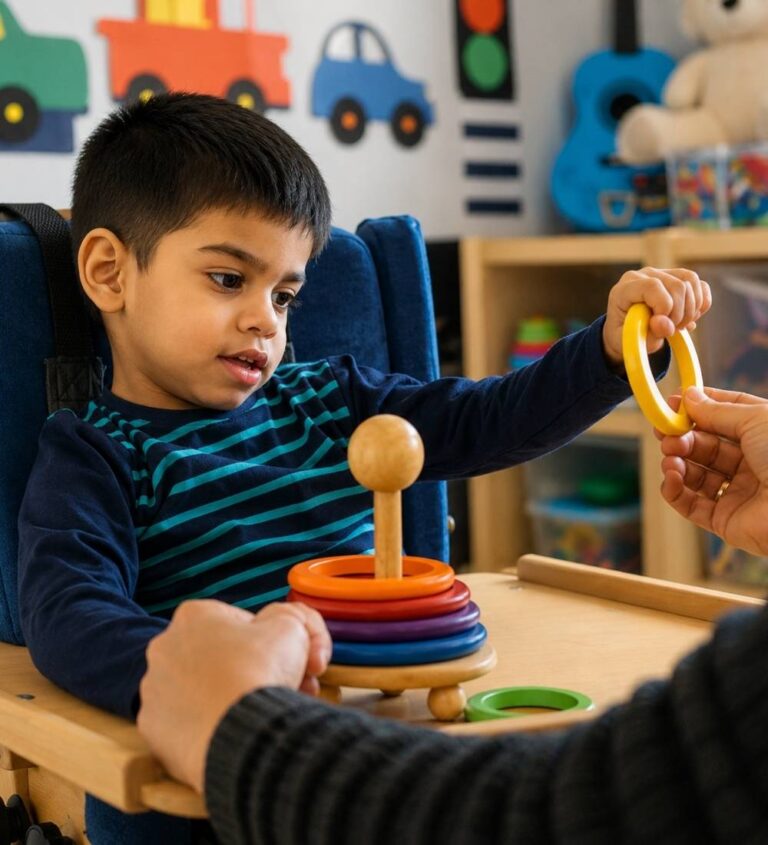
Our EI programs at Indigo are family-centered — meaning you are an active participant, not just an observer. Sessions combine elements of speech therapy, OT, developmental stimulation, and parent coaching, all delivered in a calm, nurturing environment. We also provide home program guides so every day becomes a therapy opportunity.
Why Early Intervention Matters
Research consistently shows that children who receive therapy before age 5 show significantly better outcomes in communication, behavior, learning, and independence than those who begin therapy later. If you have a concern — even a small one — trust your instinct and act early
Signs to Watch For (0–5 Years):
- Not making eye contact or responding to name by 12 months
- No babbling or gesturing by 12 months
- No single words by 16 months
- Loss of previously acquired skills at any age
- Unusual sensory reactions (extreme sensitivity to sound, touch, or light)
- Not walking independently by 18 months
Activities Gallery








FAQ
Related Questions
Regular tutoring repeats the same content in the same way — it assumes the child's learning process is typical but they just need more practice. Special education identifies how your child learns differently and uses completely different teaching strategies — multi-sensory methods, structured literacy, visual supports, and individualized pacing. It addresses the root cause of the learning difficulty, not just the surface-level academic gap
This is one of the most common profiles we see at Indigo — a child with clearly average or above-average intelligence who is significantly underperforming academically. This often indicates a specific learning disability like dyslexia, dyscalculia, or dysgraphia, or an attention-based difficulty like ADHD. A full educational assessment identifies exactly what is happening, and our special education program addresses it directly
We work with children from age 3 (pre-KG readiness) through secondary school age. For younger children, sessions focus on school readiness, pre-literacy, and pre-numeracy skills. For older children, sessions target specific academic subjects, study skills, organizational strategies, and exam preparation
No — special education at Indigo is a supplementary support program designed to work alongside your child's school. We also actively liaise with teachers and school counselors (with parent permission) to ensure strategies are consistent between home, school, and clinic. For children seeking mainstream school integration, we provide transition planning and support
"Slow learner" is an informal term sometimes used when a child's cognitive ability falls in the low-average range — not intellectual disability, but below the typical curve. These children are often overlooked because they don't qualify for formal diagnoses but still struggle significantly in a standard classroom. Indigo's special educators are experienced in working with slow learners and use paced, structured programs that build genuine academic confidence over time
We Provide The Best Offer
If Something Feels Off, Trust Your Instinct. Act Now.
The window between ages 0 and 5 is the most powerful time to intervene. Don’t wait for a formal diagnosis to seek support — early screening costs nothing and can change everything